

.png)

Reducing Manual Masking Time on Server Racks and Electrical Enclosures
For manufacturers and powder coaters supporting data center infrastructure, masking time can become a hidden production constraint. Standardizing how grounding points, threaded holes, hardware interfaces, openings, and other no-coat areas are protected can reduce manual touch time without sacrificing finishing requirements.
Server racks, cabinets, electrical enclosures, panels, frames, and power-equipment housings are some of the most visible metal components in data center infrastructure. Many rely on powder coating to provide a durable, consistent finish while moving through production at increasingly demanding volumes.
But before powder can be applied, operators may have dozens—or hundreds—of individual decisions to make.
Which threaded holes need plugs? Where does tape need to be applied? How large should the grounding mask be? Does this opening need a die-cut? Which hardware interfaces must remain coating-free? How should the part be hung?
None of those steps may seem especially time-consuming on their own. Repeated across every feature, every component, every shift, however, they can add significant manual labor to the finishing process.
For data center component manufacturers and contract powder coaters, the opportunity isn't simply to mask faster. It is to engineer unnecessary touch time out of the process while still producing the no-coat boundaries the finished component requires.
The fastest masking process isn't the one where operators work faster. It's the one that requires fewer decisions, adjustments, and manual steps per part.
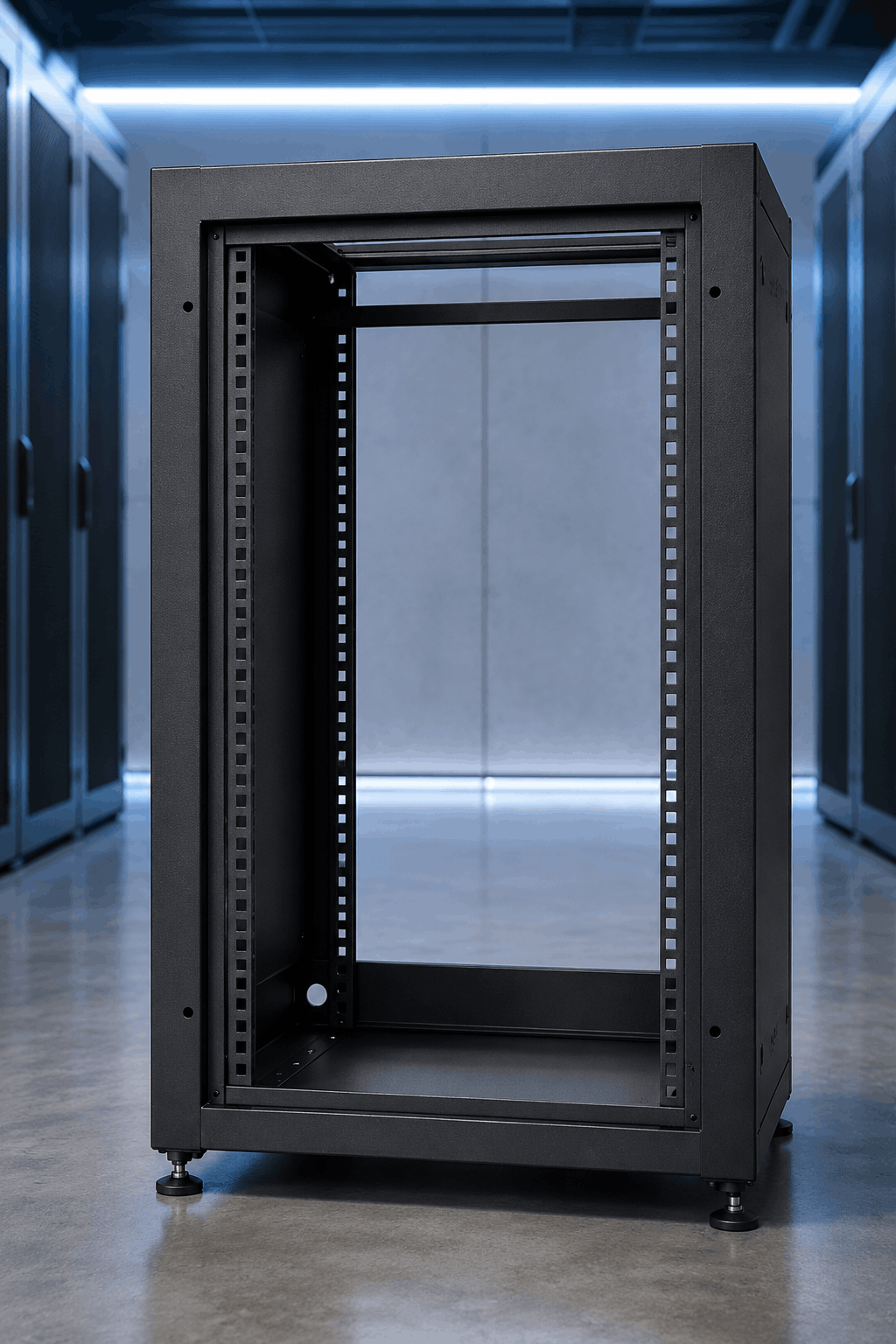
Why Server Racks and Electrical Enclosures Can Be Masking-Intensive
A large powder-coated enclosure may look relatively simple compared with a precision-machined component, but its size doesn't necessarily make masking easier.
Data center server racks, electrical cabinets, power-distribution enclosures, UPS housings, switchgear panels, structural frames, and similar fabricated components can contain many features with different finishing requirements. EPSI's broader data center guidance identifies grounding points, electrical contacts, threads, ports, sealing faces, mating surfaces, and other functional interfaces as areas manufacturers may need to protect through finishing.
Depending on the design, an enclosure might require protection around:
- Grounding and bonding locations
- Threaded holes, studs, and fasteners
- PEM hardware and other installed hardware
- Electrical contact areas
- Hinge and latch interfaces
- Mating and assembly surfaces
- Gasket or sealing areas
- Panel openings and penetrations
- Dimensional interfaces
- Labels, identification areas, or other defined keep-out zones
The labor grows when those features require different masking methods.
An operator might install plugs in threaded holes, apply tape around a larger rectangular area, place discs over grounding locations, trim another piece of tape around an irregular feature, and then inspect the component before it reaches the powder booth.
The question is: How much of that work actually needs to be manual?

Start by Measuring Masking Touch Time
Before changing the masking method, establish how much labor the current method requires.
Don't measure only the time spent putting masks onto the part.
A more complete assessment includes retrieving materials, identifying the correct masking products, measuring and cutting tape, positioning masks, trimming edges, correcting placement, loading the component, removing masks after cure, cleaning residue or unwanted coating, and returning reusable masking products.
For a server-rack frame or electrical enclosure with many protected features, small inefficiencies multiply quickly.
Consider a process that saves just 30 seconds per component. At 500 components, that eliminates more than four hours of direct touch time.
And the highest-value opportunities may save considerably more.
The goal is to identify which masking operations consume the most labor and then ask why.
Look for Repeated Features Across the Product Family
Data center equipment manufacturers often produce multiple sizes or configurations of cabinets, racks, panels, and enclosures. The finished assemblies may differ, but many of their underlying features repeat.
A family of electrical enclosures may use the same threaded hardware sizes. Multiple cabinet models may share grounding-pad dimensions. Several panels may contain identical PEM locations or connector openings.
Those repeated features create an opportunity for standardized industrial masking.
Instead of treating every part number as a completely independent masking application, manufacturers can identify common feature families and assign a repeatable masking solution to each.
For example:
M6 threaded hole = defined plug
25 mm grounding pad = defined die-cut
Specific stud diameter = defined cap
Repeated rectangular keep-out = defined pre-cut mask
This can simplify product selection, inventory, operator training, work instructions, and replenishment.
It also removes decisions from the production floor.
Every masking decision that can be made during process engineering is one less decision an operator has to make while the line is running.
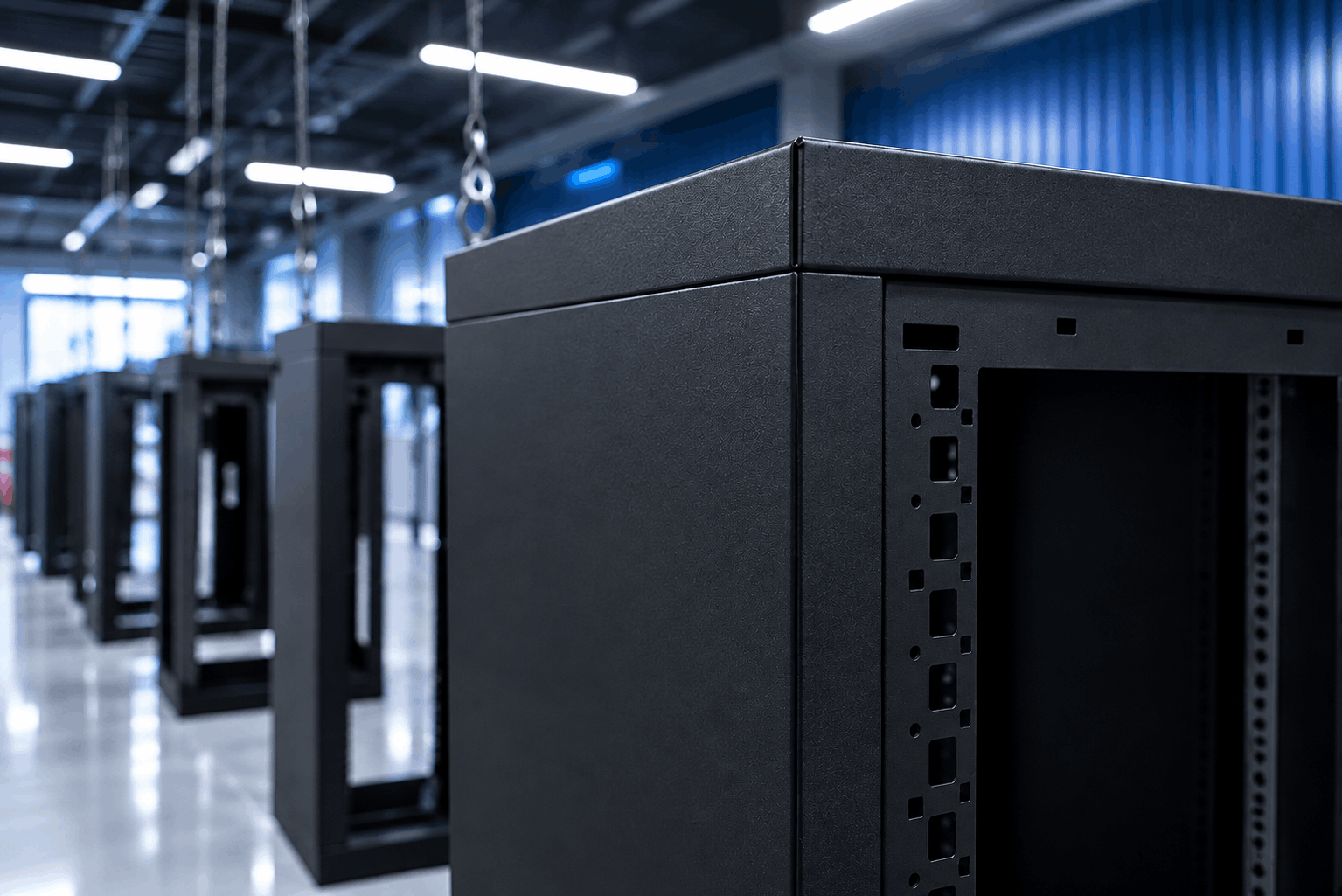
Replace Measure-Cut-Trim Work Where Possible
Manual tape is extremely versatile, which is precisely why it can become overused.
An operator can make tape conform to an enormous range of geometries. But when every component requires measuring, cutting, positioning, and trimming, flexibility comes with a labor cost.
Repeated shapes are especially worth reviewing.
A circular grounding location may be better served by a correctly sized masking disc. A repeated rectangular contact area may be a candidate for a die-cut. A complex combination of adjacent no-coat features may justify a custom masking solution.
The objective isn't to eliminate tape. Some applications are well suited to it.
Instead, identify areas where operators are effectively manufacturing the same mask by hand on every part.
If the geometry repeats, the mask may be able to repeat too.

Reduce the Number of Individual Masking Motions
Another useful metric is simply the number of masking actions required per component.
Suppose an electrical enclosure requires 24 individual plugs, six pieces of tape, four discs, and two manually trimmed masks.
That's at least 36 individual masking installations before accounting for cutting, positioning, adjustment, inspection, and removal.
Sometimes those individual masks are still the most efficient solution. In other cases, several protected features can potentially be combined into a custom molded mask, multi-feature solution, or part-specific masking kit.
The economics depend on production volume, tooling cost, expected mask life, labor savings, and process conditions.
But evaluating motions per finished part can reveal opportunities that aren't obvious when purchasing decisions focus only on unit price.
Make Correct Placement Easier
Reducing masking time should not mean accepting inconsistent boundaries.
In fact, the most effective labor-saving solutions often make correct placement easier.
Consider a grounding pad that operators currently cover with hand-cut tape. If each operator visually estimates the boundary, faster application may simply create more variation.
A pre-cut shape can eliminate cutting while giving the operator a consistent geometry to position. A plug with the appropriate fit can establish a more repeatable boundary than an improvised solution. A custom mask can potentially incorporate locating features that help it seat consistently against the component.
This matters because masking errors can move labor downstream.
Saving ten seconds during application is not an improvement if the finished component requires two minutes of coating removal or rework.
Design Demasking at the Same Time
Installation gets most of the attention when manufacturers evaluate masking labor.
Removal deserves the same scrutiny.
After powder coating and cure, operators still have to find and remove every plug, cap, disc, tape section, and custom mask.
A product that installs quickly but becomes difficult to grip after cure may simply shift labor from one end of the process to the other. Numerous small masks can also increase the chance that one remains on the component when it moves to assembly.
Evaluate:
- Removal access
- Grip points or pull features
- Number of individual masks
- Tendency to tear
- Residue or cleanup
- Ease of verifying complete removal
- Opportunities for reuse
The appropriate metric is not seconds to mask. It is total masking-related labor per acceptable finished component.
Treat Racking and Masking as One Process
Manual masking time can also be affected by how the component is presented to the operator and to the powder-coating process.
A rack determines where the component is supported, its orientation, where conductive contact occurs, how operators load and unload it, and how spray equipment accesses the surface. Reliable rack-to-part contact is also important during electrostatic powder application.
If the hanging point conflicts with a masked surface, operators may have to adjust the mask. If a large enclosure is difficult to orient, reaching masking locations may take longer. If contact points accumulate coating, operators may spend additional time correcting grounding problems.
For server racks, electrical cabinets, panels, frames, and other fabricated data center hardware, masking and racking should therefore be evaluated together.
A better mask on a poorly designed rack may only solve half of the problem.
.png)
Standardize the Work Instruction
Even the right masking product can produce inconsistent results if the process depends on tribal knowledge.
A repeatable work instruction should identify what gets masked, what product is used, where the masking boundary belongs, how the mask is installed, how the part is hung, and what operators should verify before finishing.
Photos and visual standards can be especially useful on components containing many similar holes or features.
Instead of telling an operator to “mask the grounding locations,” show exactly which locations, the required dimensions, and the approved masking product.
This becomes increasingly valuable when production spans multiple shifts, facilities, or outside finishing suppliers.
Compare Cost per Finished Part—not Cost per Mask
A roll of tape may appear inexpensive. A molded mask may appear expensive.
Neither comparison means much without labor.
A meaningful cost analysis can include masking material, reuse, application time, trimming, adjustment, demasking, cleanup, rework, scrap, inventory complexity, training, and process variation.
If a more expensive mask saves significant labor every cycle, the unit price can become a relatively small part of the equation.
The same principle applies when comparing standard products with custom masking.
High-volume data center component manufacturing magnifies small differences. Seconds saved on one enclosure become hours saved across a production run.
How EPSI Can Help
Reducing masking time on server racks and electrical enclosures starts with understanding the entire finishing process—not simply replacing one masking product with another.
EPSI works with manufacturers and contract finishers to evaluate component geometry, no-coat requirements, powder-coating conditions, grounding and hanging needs, current operator methods, production volume, demasking, and recurring sources of rework. The objective is to identify where standardization or a different masking and racking approach can remove unnecessary steps while maintaining the required finished condition.

Caps, Plugs, Tapes & Discs
Protect recurring threads, studs, grounding points, openings, and other no-coat areas with standardized masking products that simplify application and inventory.
Explore Masking
Custom Masking
Replace repetitive cutting, trimming, and multi-piece masking with application-specific solutions designed around recurring component geometry & production requirements.
Explore Custom
Custom Racking
Optimize hanging for large frames, panels, cabinets, and enclosures with racking designed for reliable contact, efficient loading, stability, and coating access.
Explore Racking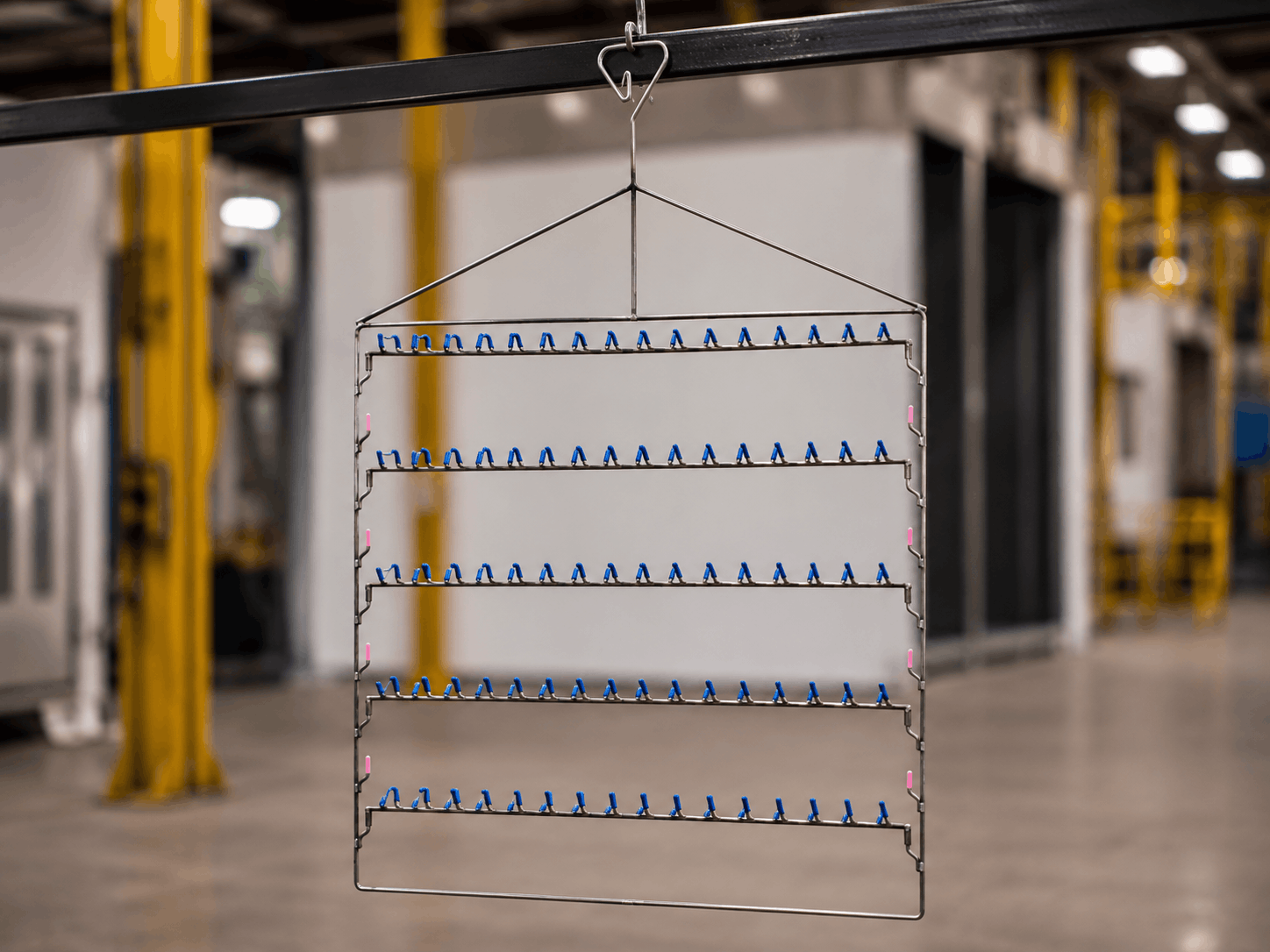
Modular Racking
Adapt hanging configurations for changing component sizes and production mixes with flexible frames, crossbars, hooks, and other modular racking components.
Explore Modular RackingThe Goal Is Fewer Manual Decisions per Part
Reducing masking labor doesn't require operators to move faster.
A better objective is to give them less manual work to perform.
Standardize repeated features. Replace recurring hand-cut shapes where practical. Reduce the number of individual masking motions. Make correct placement obvious. Consider demasking before choosing the mask. And evaluate the rack, mask, component, and operator method as one finishing system.
For manufacturers scaling production of powder-coated server racks, electrical enclosures, cabinets, frames, and other data center hardware, those improvements can turn masking from a collection of manual tasks into a controlled manufacturing process.
The result isn't simply faster masking. It's a process that's easier to repeat.
Frequently Asked Questions
Why do some surfaces need to remain uncoated during powder coating?
Some surfaces perform electrical, mechanical, sealing, or dimensional functions that coating could interfere with. Examples include grounding points, electrical contacts, threads, gasket surfaces, mating areas, and precision interfaces. The component drawing and qualified finishing process should define the required no-coat areas.
How does pretreatment affect masking selection for data center hardware?
Masking products may be exposed to more than the powder-coat oven. Depending on the finishing line, data center components can encounter cleaning solutions, rinses, conversion coatings, spray pressure, and other pretreatment conditions before powder is applied. A mask that tolerates the cure temperature still needs to remain secure and functional throughout the complete finishing process. Mask selection should therefore consider pretreatment chemistry and exposure as well as cure temperature and dwell time.
Can powder coating interfere with electrical grounding?
Powder coating is generally electrically insulating, so designated grounding or bonding surfaces may need to remain free of coating to maintain the metal-to-metal contact required by the equipment design. Proper rack-to-part contact is also important during electrostatic powder application.
How should manufacturers validate a new masking process for data center components?
A new masking method should be evaluated under the actual production conditions it will encounter, including pretreatment, handling, powder application, cure temperature and dwell time, cooling, and mask removal. Finished components should then be inspected against the applicable drawing and customer requirements. Depending on the application, qualification may also include electrical continuity, grounding, sealing, dimensional, or final assembly testing.
How do you protect threaded holes during powder coating?
High-temperature masking plugs are commonly used to protect internal threads, while caps can protect studs and external features. The appropriate product depends on the thread or opening geometry, masking depth, cure temperature, pretreatment chemistry, installation requirements, and desired coating boundary.
What causes powder coating to leak underneath a mask?
Powder intrusion can result from poor mask fit, incorrect sizing, inconsistent installation, inadequate sealing at an edge, part geometry, or a mask shifting during processing. Repeated leakage at the same location may indicate that the masking method itself should be reevaluated. A different standard mask, die-cut shape, or custom solution may create a more repeatable no-coat boundary.
What is the best way to mask grounding points?
The best method depends on the size, shape, location, process conditions, and production volume. High-temperature tape, discs, die-cuts, plugs, caps, and custom masking may all be appropriate. For repeat production, a standardized mask can improve placement consistency compared with repeatedly measuring and trimming material by hand.
When should a data center equipment manufacturer move from hand masking to a standardized masking method?
Hand-cut tape can be practical for prototypes, low-volume production, and frequently changing geometries. As production volume increases, however, repeated measuring, cutting, positioning, trimming, and removal can become significant sources of labor and variation. If operators repeatedly create the same mask by hand, it may be worth evaluating pre-cut tape shapes, standard caps or plugs, reusable masks, or custom molded masking.
Can coating thickness affect component assembly?
Yes. At close-tolerance mating or dimensional interfaces, coating buildup can affect fit, alignment, hardware seating, or other assembly requirements. Engineering drawings should identify surfaces where coating thickness cannot be accommodated.
What should contract powder coaters request from data center equipment manufacturers before quoting a job?
Useful information includes current drawings, clearly identified no-coat areas, coating specifications, critical dimensions, grounding or contact requirements, expected production volumes, and any customer-specific inspection or testing requirements. Understanding recurring production volume is also important because the most economical masking method for a prototype or short run may be very different from the best method for ongoing production.
When does custom masking make sense?
Custom masking can make sense when standard products require multiple pieces, extensive hand trimming, inconsistent placement, difficult removal, or excessive operator time. Production volume, labor savings, quality requirements, and mask reuse should all be considered when comparing custom and standard solutions.
How should no-coat areas be inspected after powder coating?
Inspection should be based on the functional requirements of the component rather than simply whether the masked area looks clean. Depending on the application, manufacturers may need to verify masking boundaries, absence of unwanted coating, thread functionality, dimensional requirements, electrical continuity, grounding performance, sealing performance, or final assembly fit. Critical acceptance requirements should be defined in the work instructions or quality plan before production begins.
Does racking affect no-coat areas during powder coating?
Yes. Racking determines part support, orientation, conductive contact, spacing, and coating access. Hanging points and rack geometry should be considered alongside masking so that the rack does not interfere with protected surfaces and maintains reliable contact throughout the finishing process.
Need Help Reducing Masking Time on Data Center Components?
Bring EPSI your server rack, cabinet, electrical enclosure, panel, or frame; the required no-coat areas; current masking method; powder-coating process; production volume; and current labor challenges. EPSI can help evaluate standard masking, custom solutions, and racking around the application.