
.png)
The $2 Hook That Costs You Hundreds: The Hidden ROI of Replacing Powder Coating Hooks
In industrial surface finishing, manufacturers carefully evaluate coating materials, equipment efficiency, labor requirements, and production capacity. Yet the small components supporting those operations can have an equally important influence on profitability. Powder coating hooks are a perfect example: inexpensive individually, but essential to grounding, part positioning, and consistent production.
The real question isn't simply how long a hook can remain in service. It's whether keeping that hook in service is still economical.
Understanding the return on investment (ROI) of replacing hooks requires looking beyond their purchase price and examining the cumulative cost of poor contact, additional labor, rework, and lost throughput.
The true cost of a hook isn't what you pay to purchase it. It's what that hook costs your operation every time it goes through the finishing line.
The True Cost of a Powder Coating Hook
The purchase price of a hook is easy to measure. Its total operating cost is more complicated.
A hook's financial impact extends into several areas of manufacturing efficiency:
- Coating quality: Poor electrical contact can contribute to inconsistent powder application and additional rework.
- Labor efficiency: Difficult loading, unloading, or repositioning increases handling time.
- Material consumption: Grounding problems may reduce transfer efficiency and contribute to unnecessary powder usage.
- Production capacity: Reworked parts consume time that could otherwise support new production.
- Maintenance: Repeated cleaning and troubleshooting can eventually cost more than replacement.
Not every worn hook causes these problems, and not every coating defect originates at the hook. However, when hook-related issues become recurring contributors to production losses, replacement can become a financially justified improvement.
How Small Hook Problems Become Large Manufacturing Expenses
1. Rework Multiplies the Cost of a Single Part
A finishing defect rarely represents only the cost of additional powder.
Depending on the defect and process requirements, rework may involve inspection, handling, stripping or surface preparation, recoating, curing, and another quality check.
Consider a hypothetical operation producing 10,000 parts monthly.
If hook-related problems contribute to a 1% rework rate, that's 100 parts requiring additional attention. At an estimated $15 in incremental rework costs per part, the operation incurs $1,500 in monthly expenses.
That's $18,000 annually, assuming consistent production volume and defect rates.
The example is illustrative, not a measured EPSI customer result. Actual costs depend on part complexity, process requirements, labor rates, and the extent of rework.
Nevertheless, it demonstrates why even relatively small improvements in first-pass yield deserve attention.
2. Extra Handling Time Accumulates Across Thousands of Parts
A hook that no longer fits or positions a component properly may require operators to make adjustments during loading.
Five additional seconds might seem insignificant.
Across 10,000 parts, however, five seconds represents nearly 14 hours of accumulated handling time.
At a loaded labor rate of $30 per hour, that equals approximately $417 in monthly labor capacity.
Those hours don't automatically become cash savings. Their financial value depends on whether the recovered time reduces overtime, eliminates unnecessary work, or allows employees to complete additional productive tasks.
For high-volume manufacturers, even modest improvements in loading efficiency can become meaningful over time.
3. Lost Throughput Creates Opportunity Costs
Production capacity is valuable because every finishing cycle consumes resources.
When unstable hanging, inconsistent contact, or repeated adjustments slow production, manufacturers may lose usable line capacity.
This becomes especially important when the finishing line is already a bottleneck.
A hook replacement program that improves process reliability may help preserve available capacity without requiring additional equipment.
The value depends on production demand, scheduling constraints, and whether the recovered capacity can actually be used.
Calculating the ROI of Replacing Powder Coating Hooks
Rather than evaluating hook replacement as an isolated purchasing expense, manufacturers can compare its cost against measurable process improvements.
A practical calculation begins with three categories:
|
Cost category |
What to measure |
|---|---|
|
Replacement investment |
Hook purchase cost, installation labor, and related downtime |
|
Current operating losses |
Hook-related rework, extra handling, cleaning, and interruptions |
|
Expected improvement |
Reduction in those losses after replacement |
The basic calculation is:
ROI (%) = [(Financial Benefits − Replacement Investment) ÷ Replacement Investment] × 100
Example: What Could a $200 Hook Investment Return?
Imagine a finishing operation replacing 100 hooks at $2 each.
The total hook purchase cost is $200. For this simplified example, assume installation is completed during scheduled maintenance without incremental labor or downtime costs.
If the replacement eliminates $600 in verified hook-related operating losses over the evaluation period:
-
Replacement investment: $200
-
Avoided operating costs: $600
-
Net financial benefit: $400
-
Calculated ROI: 200%
This doesn't mean every $200 hook purchase generates $600 in savings. The benefit must be measured against actual operating conditions, and the calculation should include any additional implementation costs.
The important takeaway is that replacement decisions should consider the cost of continuing to use underperforming hooks—not simply the cost of buying new ones.
A hook doesn't have to fail completely to become an expensive part of your process. Sometimes, the costliest hook is the one you keep using.
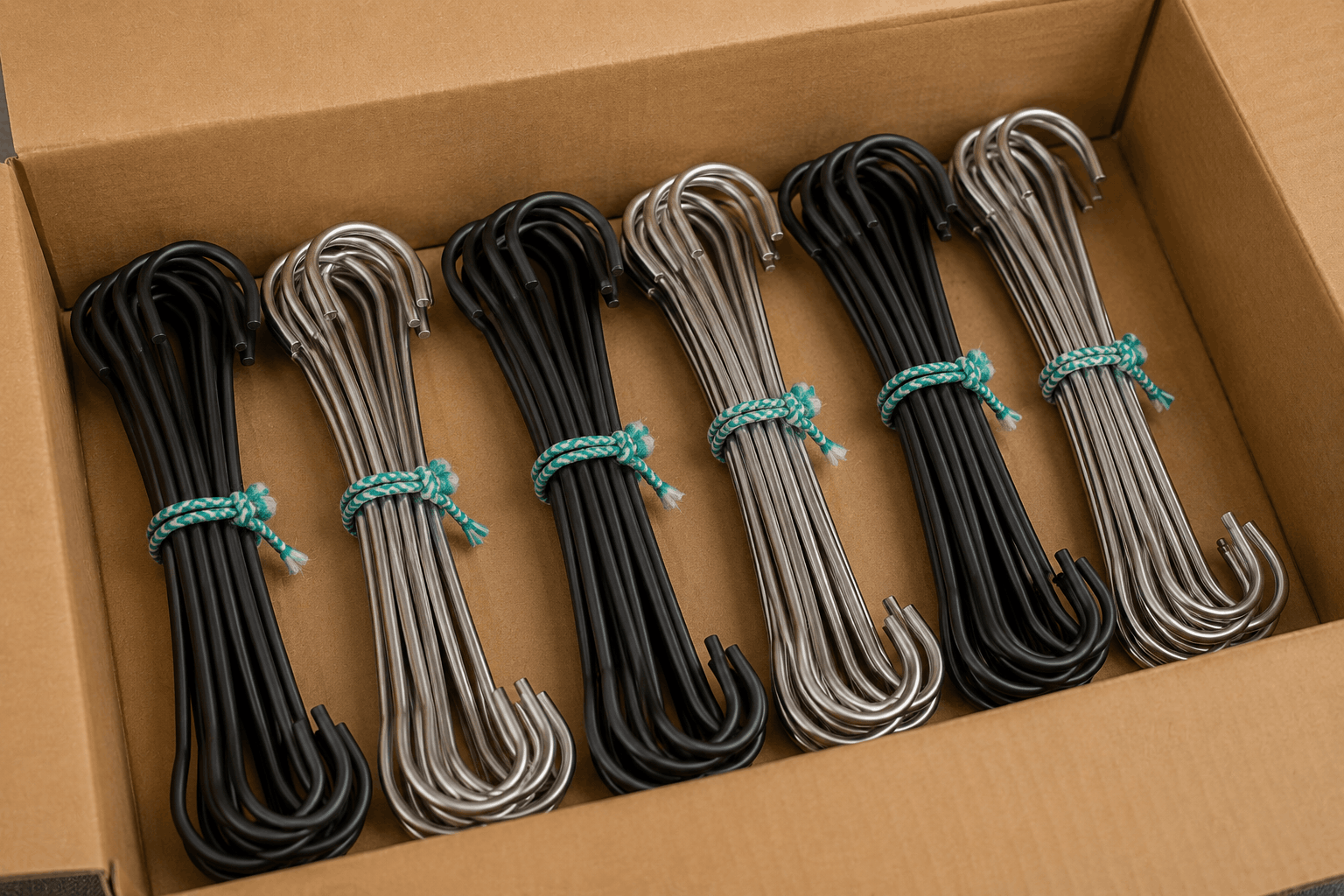
Why Proactive Hook Replenishment Can Outperform Reactive Replacement
Reactive replacement typically begins when a problem becomes noticeable. Proactive replenishment focuses on maintaining reliable performance before production is disrupted.
That doesn't mean replacing every hook on a fixed schedule regardless of condition.
A more effective approach combines inspection findings, application requirements, cleaning effectiveness, and production history.
Manufacturers can begin by identifying high-use hanging points, tracking recurring hook-related defects, and maintaining appropriate replacement inventory.
The objective is to replace hooks when their continued use creates unnecessary cost or unacceptable process risk.
For operations with multiple production lines or frequently changing part configurations, standardizing commonly used hook styles can also simplify replenishment and purchasing.
How EPSI Can Help
Improving hook ROI involves more than ordering replacement parts. It requires understanding how hooks interact with racking, grounding, part geometry, and the overall finishing process.
EPSI offers industrial hanging and racking solutions that help manufacturers address these connected challenges. Whether the goal is maintaining dependable hook inventory, restoring existing racks, or improving part presentation, the right solution begins with the specific demands of the operation.
Hooks
EPSI offers multiple industrial hook designs for different part geometries, loads, and finishing requirements. Selecting suitable replacement hooks helps support reliable contact, secure hanging, and efficient loading.
Explore Hooks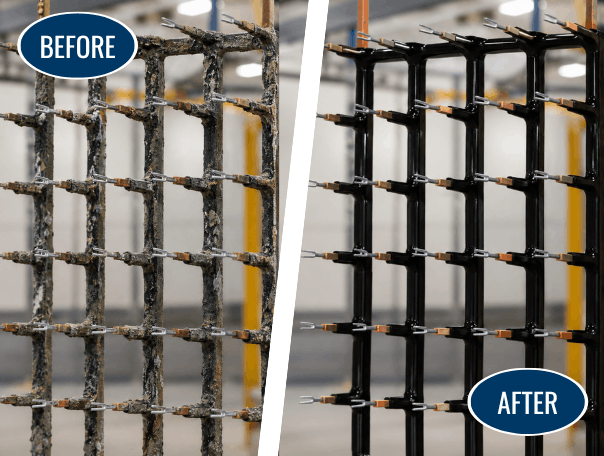
Rack Refurbishment
When hooks are only part of a larger racking problem, refurbishment may provide a more economical alternative to complete replacement. Cleaning, straightening, and replacing worn components can help restore usable rack performance.
Explore Rack Refurbishment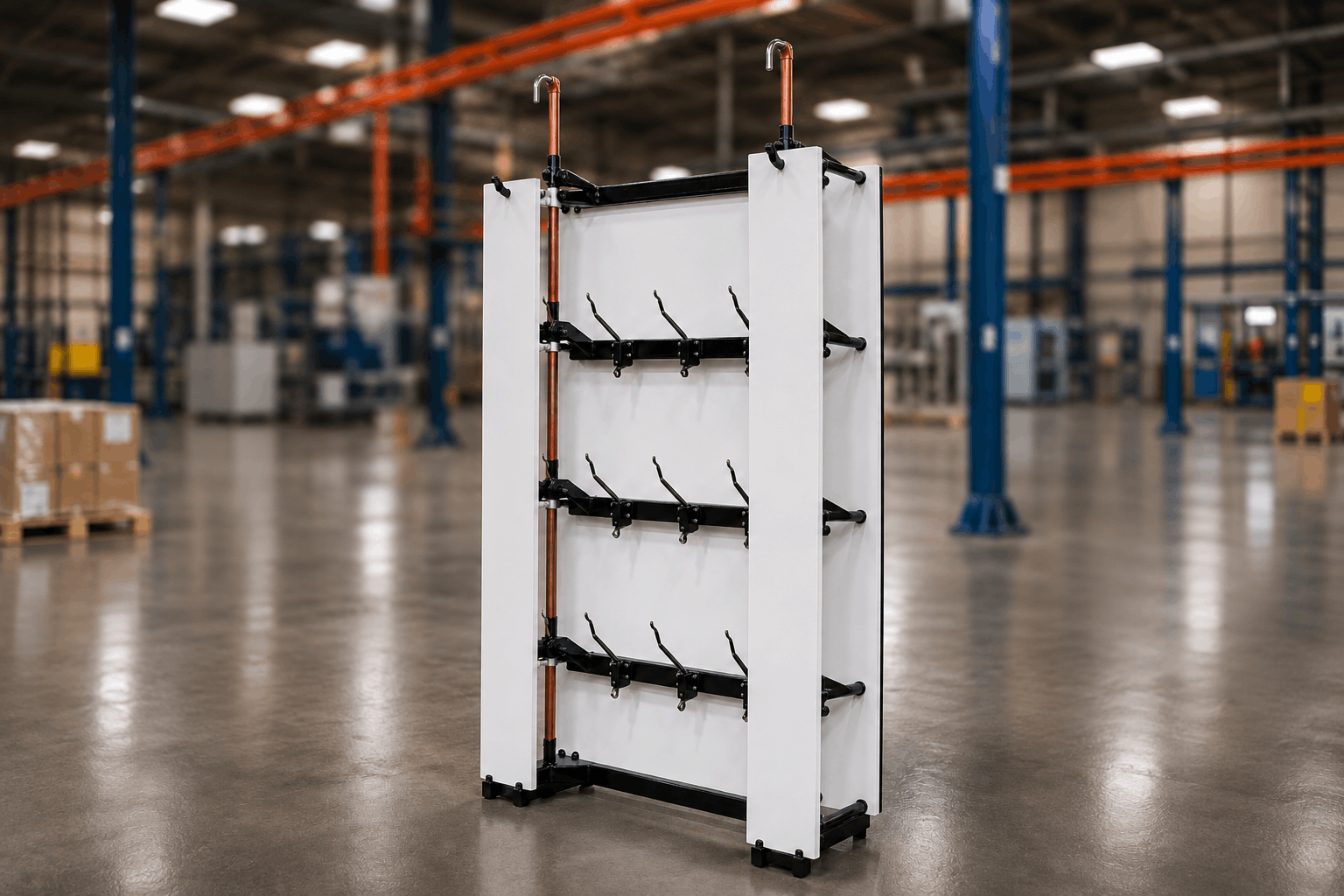
Custom Racking
For complex components or demanding production environments, custom-engineered racks can improve how parts are supported and presented. Optimized contact locations, spacing, and loading arrangements may reduce handling difficulties and support repeatable finishing.
Explore Custom Racking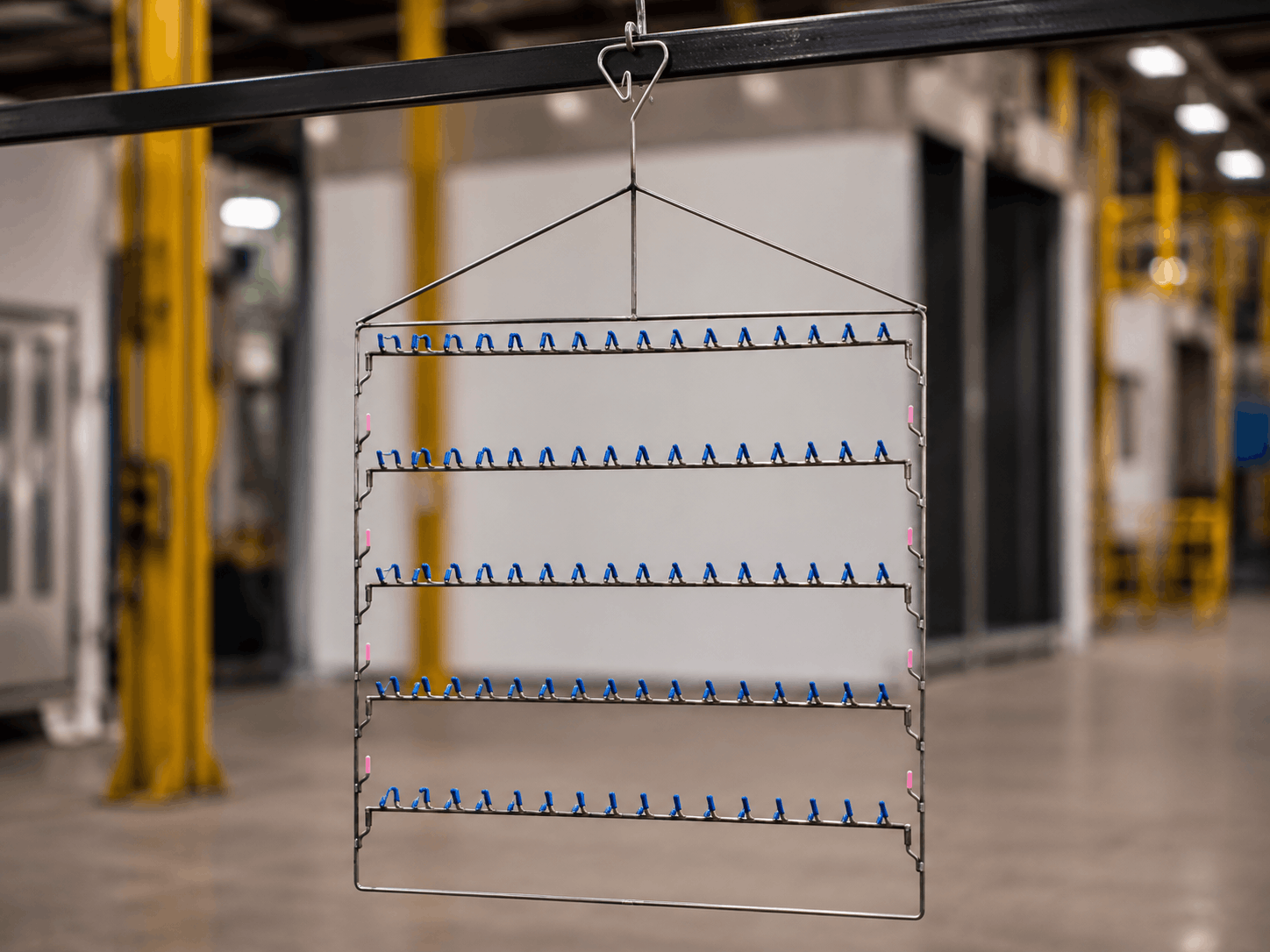
Modular Racking
Modular racking provides flexibility when part sizes, production volumes, or hanging requirements change. Interchangeable crossbars and hook configurations allow manufacturers to adjust setups without necessarily replacing entire rack assemblies.
Explore Modular RackingThe Bottom Line: Small Investments Can Protect Larger Returns
Manufacturing efficiency isn't determined only by major equipment investments. Small, frequently used components can influence the performance of an entire finishing operation.
Powder coating hooks are a clear example.
Their purchase price may be modest, but their effect on grounding, handling, rework, and throughput can be significant.
For manufacturers looking to improve surface finishing ROI, the opportunity isn't necessarily to replace hooks more often. It's to replace them more intelligently—using performance data, preventative maintenance, and an understanding of total operating cost.
Frequently Asked Questions
How does replacing powder coating hooks improve ROI?
Replacing underperforming hooks can reduce avoidable costs associated with rework, additional handling, inconsistent grounding, and production interruptions. The financial benefit depends on the problems replacement actually resolves. Manufacturers should compare documented operating improvements against the full replacement investment.
Are more expensive powder coating hooks worth the investment?
Potentially. A higher-priced hook may provide better value if its geometry, durability, or handling characteristics improve performance for the application. However, price alone doesn’t establish quality. Evaluate expected service life, contact reliability, loading efficiency, and total cost per productive cycle.
How much can manufacturers save by replacing worn hooks?
Savings vary substantially. A high-volume operation experiencing measurable hook-related rework may realize greater benefits than a low-volume facility with minimal defects. The most reliable approach is to measure current losses, replace a controlled group of hooks, and compare results under similar production conditions.
Can worn hooks increase powder coating material costs?
Yes, when deteriorated contact points interfere with the electrical grounding needed for electrostatic powder application. Poor grounding can contribute to inefficient powder deposition and inconsistent coating results. However, powder consumption is also affected by spray settings, part geometry, reclaim practices, and other process variables.
Is cleaning hooks more economical than replacing them?
Cleaning may be more economical when it reliably restores acceptable contact and function without damaging the hook. Replacement becomes more attractive when repeated cleaning consumes excessive labor, fails to restore performance, or leaves the hook mechanically unsuitable. Compare cleaning costs and usable service life with the cost of replacement.
Should manufacturers replace all powder coating hooks at once?
Not necessarily. Targeted replacement may be more economical when only certain hooks are underperforming. A broader replacement program can make sense when an entire group has similar wear, cleaning history, or reliability problems. Decisions should follow inspection results and production requirements rather than a universal replacement interval.
How do powder coating hooks affect manufacturing throughput?
Hooks influence loading speed, part stability, spacing, and the consistency of part presentation. Poorly suited or damaged hooks can require extra adjustments and may contribute to interruptions or rework. Improving these conditions can preserve productive capacity, particularly when the finishing line limits overall manufacturing output.
What metrics should manufacturers track to measure hook replacement ROI?
Useful metrics include hook-related defect rates, first-pass yield, rework hours, loading time per part, cleaning labor, replacement frequency, and unplanned interruptions. Track the same metrics before and after replacement while accounting for changes in part mix, operators, coating materials, and production volume.
How can a hook replenishment program support preventative maintenance?
A replenishment program helps ensure suitable replacements are available when inspections identify deteriorating performance. Standardizing frequently used hook types, maintaining appropriate inventory levels, and coordinating replacement with planned maintenance can reduce emergency purchasing and avoidable delays.
Are Your Hooks Costing You More Than They Should?
From worn contact points and inefficient loading to recurring rework, EPSI can help you evaluate hook replacement and racking options that support more reliable, cost-effective finishing.